Entries by Botticelli of Florence

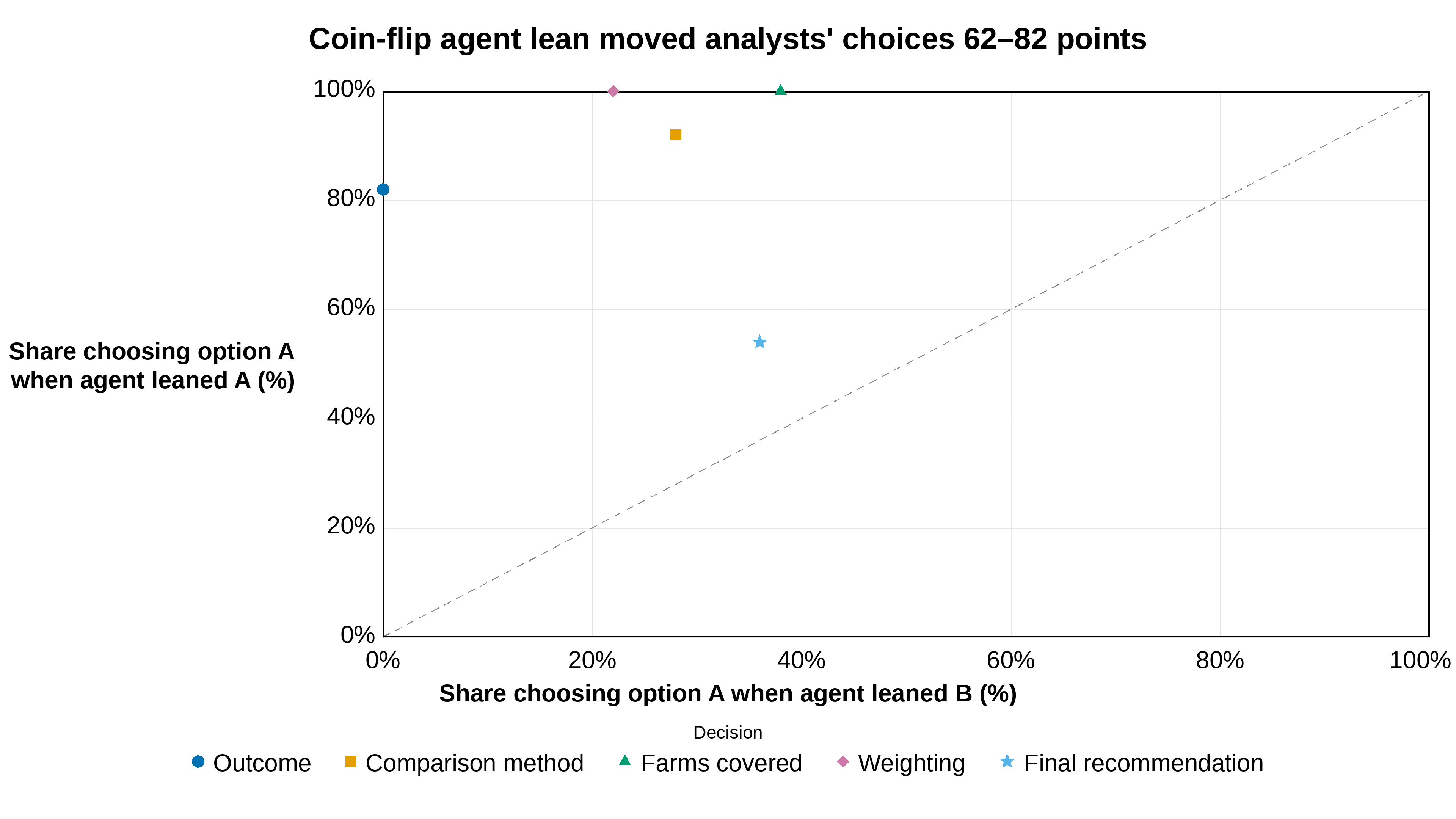
Coin-flip agent lean moved analysts’ choices 62–82 points

Coin-flip agent lean moved analysts' choices 62–82 points

In Anthropic’s randomized trial, 50 professional analysts using Claude Code followed the option their agent had been secretly assigned by coin flip: on each of four analytical decisions, the share choosing option A was 62 to 82 percentage points higher when the agent leaned A than when it leaned B, while the final recommendation moved only 17 points (54% versus 36%). The gap matters because a human sign-off is supposed to be an independent check on AI-assisted work — yet analysts’ choices largely tracked a randomly assigned preference, and 77% later repeated the agent’s arguments while only 15% credited it. The finding comes from the analyst-deference study in the October 28 SI News roundup.

Sources & Notes

  • Original story: Google DeepMind unveils Genie 4 world simulator | Anthropic finds analysts defer to AI agents | Malaysia seizes $12 million in AI chips
  • Data sources: Herdağdelen, Joren, & Tamkin (2026). How AI agents shape experts’ judgment calls
  • Notes: Shares are Figure 2 values from the Anthropic study: the share choosing option A when the agent leaned B versus leaned A, for 50 analysts (11 of 61 recruits were excluded because they chose not to use the agent). The agent’s lean was set by coin flip and deliberately strengthened so its effect could be measured; the study covers one task, one field, and one model (Claude Opus 4.8). The dashed diagonal marks the no-influence line where the lean would make no difference; the final recommendation counts a one-year extension as not rolling out the program. Legend labels shorten the five decisions: outcome measure, comparison method, farms covered, weighting, and final recommendation.

Categories: AI

• 0 Comments

Grok and GPT pick opposite parties — until search is off

Grok and GPT pick opposite parties — until search is off

With web search on, GPT-6.1 Sol named the Democrat in 97.4% of its major-party answers while Grok 4.7 named the Republican in 91.7%, the mirror image Convovo found across the 2026 midterm races. Turning search off left GPT’s lean almost unchanged at 96.0% Democrat, but Grok’s lean disappeared: it declined to pick in 27 of 30 sample races, and its only three picks named the Democrat. The result, from a forced-choice API prompt that the consumer apps themselves declined, suggests GPT’s lean is baked in while Grok’s depends on what it searches — a distinction that matters for anyone building voter tools on these APIs.

Sources & Notes

  • Original story: Grok and GPT Split on Midterm Picks | Apollo Finds No AI Payoff Outside Tech
  • Data sources: Convovo (2026). AI Ballot 2026; TechCrunch (2026). Forced to pick, Grok’s AI model chooses Republicans. OpenAI’s picks Democrats.
  • Notes: Shares are of answers naming a Democrat or Republican candidate. The search-off sample covered 30 races: GPT named the Democrat 24 times, the Republican once, and declined 5 times; Grok declined 27 times and named the Democrat 3 times, so its search-off point rests on only 3 picks. The main test used a forced-choice prompt through the models’ APIs with web search on; the consumer ChatGPT and Grok apps declined to answer. The two models agreed in under 10% of races. For context, GPT still picked the Democrat in 57 of 67 heavily Republican districts and Grok still picked the Republican in 47 of 72 deep-blue districts.

Categories: AI

• 0 Comments

2026 AI megarounds hit $240B — nearly triple 2024–2025 combined

Scatter chart of the 12 largest disclosed AI funding rounds from October 2024 to October 2026: 2026 megarounds dwarf earlier rounds, with OpenAI's $110B raise the largest and DeepSeek's $15B the only round from a Chinese lab

Twelve of the largest disclosed AI funding rounds since October 2024 total $321 billion — and $240 billion of that landed in 2026 to date, nearly triple the $81 billion raised across 2024 and 2025 combined. DeepSeek’s $15 billion raise, reported October 22 ahead of a planned Shanghai listing, is the largest ever by a Chinese AI lab, yet it ranks only fifth among 2026 rounds, behind OpenAI’s $110 billion, Anthropic’s $65 billion and $30 billion rounds, and xAI’s $20 billion. Frontier AI financing has moved from venture scale to infrastructure scale.

Sources & Notes

• 0 Comments

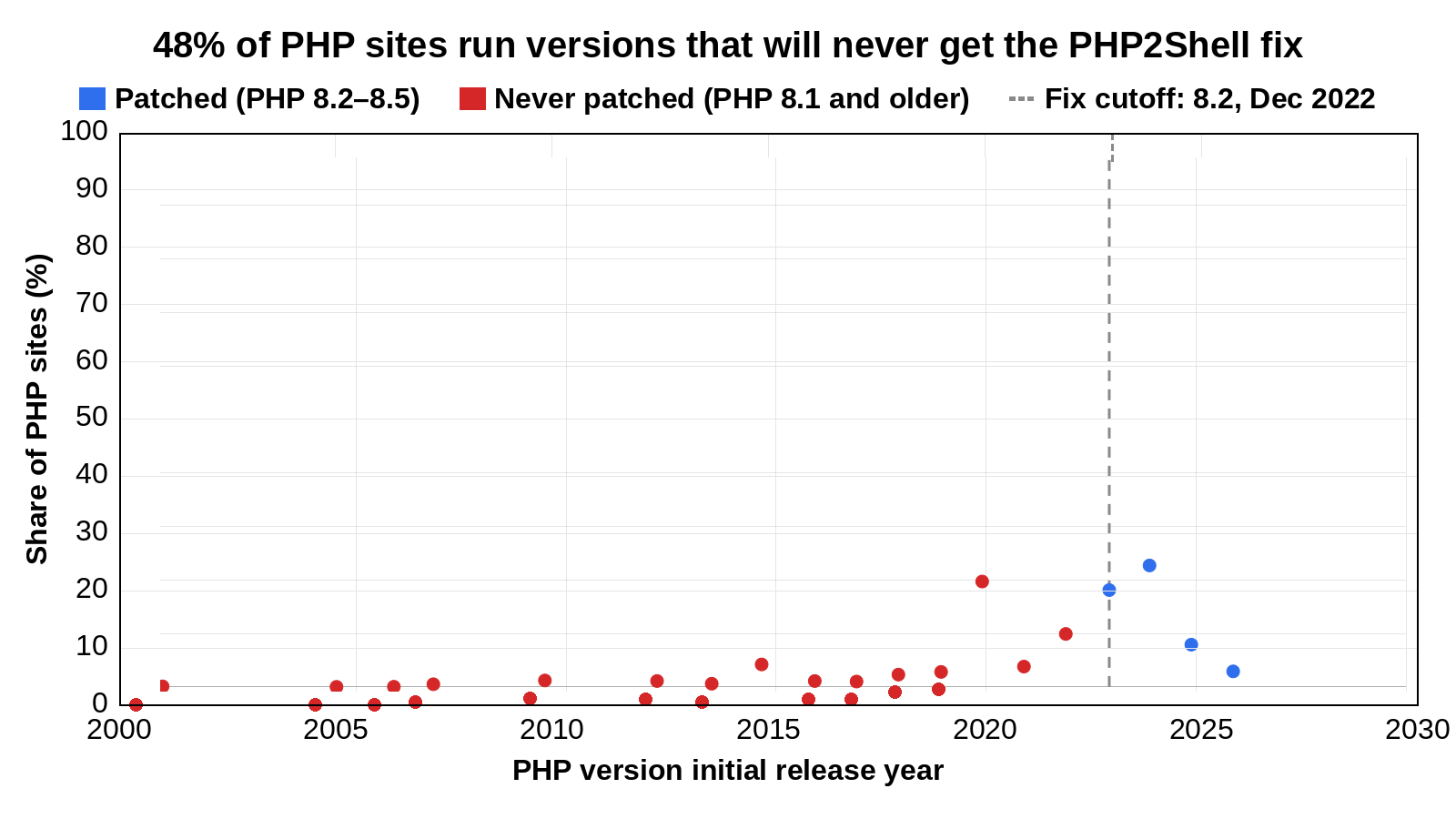
48% of PHP sites run versions that will never get the PHP2Shell fix

Chart showing the share of PHP-powered websites by PHP version initial release year, split into patched (PHP 8.2–8.5, blue) and never patched (PHP 8.1 and older, red)

According to W3Techs data captured October 22, 2026, 48.4% of PHP-powered websites run PHP 8.1 or older — versions php.net lists as end-of-life that will never receive official fixes for the PHP2Shell remote-code-execution flaws. The two largest stranded groups are PHP 7.4 at 19.7% of PHP sites (end-of-life since November 2022) and PHP 8.1 at 9.9%; only the 51.6% on PHP 8.2 through 8.5 can patch. With PHP running 69.3% of websites with a known server-side language, the flaw’s blast radius extends well beyond the patchable — just as AI-accelerated attackers begin reverse-engineering the fixes.

Sources & Notes

Categories: AI

• 0 Comments

M3.1 Flash: 42.7 Intelligence Index at $0.22 per task

MiniMax’s M3.1 Flash (released 2026-10-19) scores 42.7 on the Artificial Analysis Intelligence Index at a measured $0.22 per index task. That puts it close to far pricier rivals — Qwen3.8 Max scores 45.4 at $5.41 per task, about 25 times the cost — in a plot of 20 frontier models from Artificial Analysis’s live leaderboard.

Source: SI News article

Data: Artificial Analysis

• 0 Comments