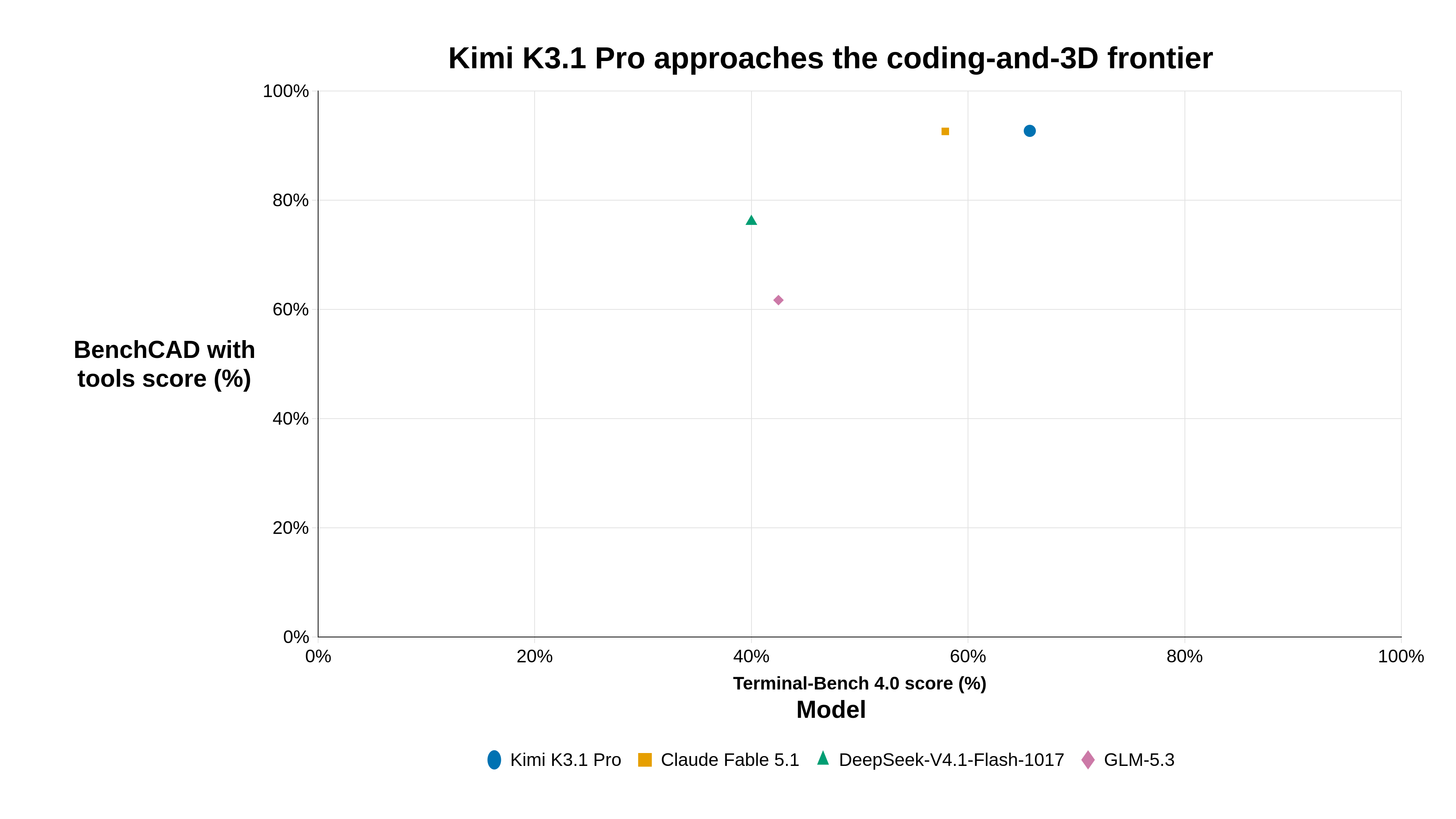
On the launch post's comparable evaluations, Kimi K3.1 Pro scores 65.7% on Terminal-Bench 4.0 and 92.7% on tool-assisted BenchCAD, putting it close to Claude Fable 5.1 and behind only the strongest model on the two-axis frontier. The convergence across coding-agent execution and 3D reconstruction matters because the SI News story presents K3.1 Pro as a broad open-weight challenger rather than a single-benchmark specialist.
Of the 116 open-weight language models with at least 100 billion parameters that Epoch AI records since 2024-01-01, 70 come from Chinese developers, and all 13 that reach 1 trillion parameters or more do, from Moonshot’s Kimi K2 in July 2025 to Kimi K3 (2.8 trillion) and Alibaba’s Qwen3.8 (2.4 trillion) in mid-2026. The largest open-weight model has grown about fourfold since DeepSeek-V3’s 671 billion parameters in December 2024, while the biggest from a developer outside China is Thinking Machines’ Inkling at 975 billion. Moonshot’s 3-trillion-class Kimi K3.1 Pro, covered by SI News, would extend that lead when its weights arrive on November 4, though size alone has not closed the capability gap to closed models.
Notes: Each marker is one model in Epoch AI’s database whose domain includes language, whose accessibility is any open-weights category (unrestricted, restricted use or non-commercial), whose recorded total parameter count is at least 100 billion, and whose Epoch publication date falls between 2024-01-01 and 2026-10-25; duplicate names were dropped. Mixture-of-experts models are plotted at total, not active, parameters (Kimi K3 activates 104 billion of 2.8 trillion), and the dashed line marks 1 trillion. Country is Epoch’s developer-organization country, with one model lacking a country (Cogito v2.1) counted in Rest of world; Epoch publication dates can precede weight release (Kimi K3 was announced 2026-07-16 and its weights published 2026-07-27). Kimi K3.1 Pro is not plotted because Epoch lists it as API access with no parameter count. Data downloaded 2026-10-25; Kimi K3 and Qwen3.8 parameter counts were checked against their model cards.
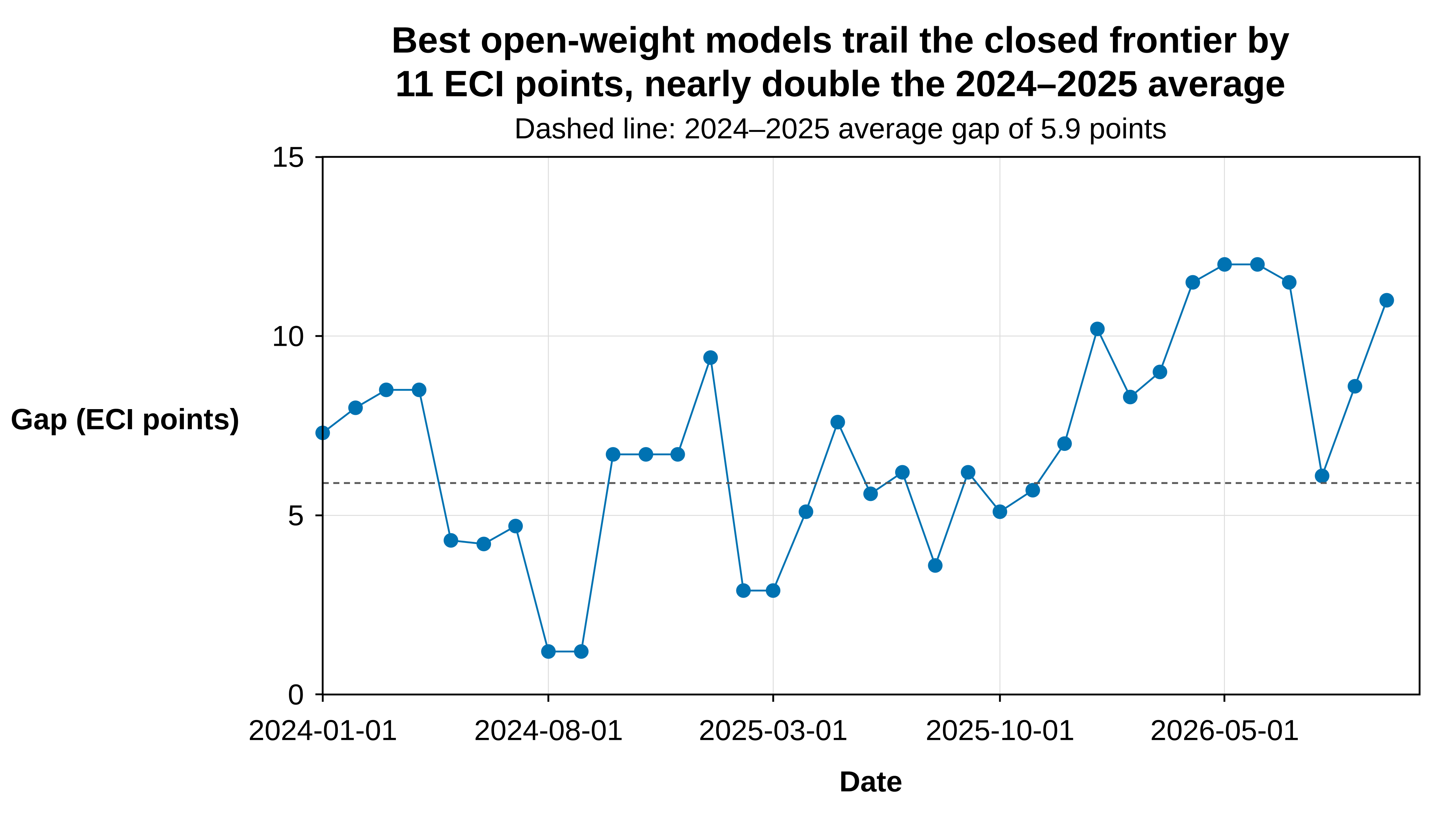
On the Epoch Capabilities Index (ECI), the best closed-weight model (Claude Opus 5.5, 168.8) led the best open-weight model (Moonshot’s Kimi K3, 157.9) by 11.0 points on 2026-10-01, compared with an average gap of 5.9 points across 2024 and 2025 and 10.1 points so far in 2026. Kimi K3’s July release briefly cut the gap to 6.1 points before Claude Fable 5.1, GPT-6 Astra and Claude Opus 5.5 reopened it in September, so open-weight models are improving quickly but the closed frontier has moved faster this year. That is the bar facing Kimi K3.1 Pro, a post-trained successor to K3 whose strong self-reported coding and agent benchmarks SI News calls a notable new challenge to proprietary frontier models, with weights promised by November 4 and no ECI score yet.
Notes: Each point is the gap, on the first day of each month from 2024-01-01 to 2026-10-01, between the highest central ECI estimate among models in Epoch’s Closed weights group and the highest among models in its Open weights group (which includes restricted-use and non-commercial licenses; Kimi K3 is non-commercial) released on or before that date. Models Epoch classifies as Other (unknown or limited access, such as Gemini 4 Argon at 166.5) are excluded, and the gap was unchanged at 11.0 points on 2026-10-24. Data were downloaded on 2026-10-24 from the CSV Epoch updated that day; the confidence intervals for the current leaders span roughly 5 to 9 points and shift when Epoch refits the index, which is why Epoch’s May 2026 analysis reported an average gap of about 8 points since January 2026 while the current fit gives about 10.5 points for 2026-01-01 to 2026-05-29. Kimi K3.1 Pro’s benchmark results are self-reported by Moonshot AI and not yet in the ECI.
Twelve of the largest disclosed AI funding rounds since October 2024 total $321 billion — and $240 billion of that landed in 2026 to date, nearly triple the $81 billion raised across 2024 and 2025 combined. DeepSeek’s $15 billion raise, reported October 22 ahead of a planned Shanghai listing, is the largest ever by a Chinese AI lab, yet it ranks only fifth among 2026 rounds, behind OpenAI’s $110 billion, Anthropic’s $65 billion and $30 billion rounds, and xAI’s $20 billion. Frontier AI financing has moved from venture scale to infrastructure scale.
Notes: Twelve largest disclosed primary AI funding rounds, October 2024–October 2026, $2B minimum. Excludes xAI’s July 2025 $10B financing ($5B debt plus $5B equity), unclosed or amount-uncertain 2026 rounds, and single-source raises. Amounts are announced totals; portions of the OpenAI $110B and xAI $20B rounds were reported as conditional or tranched.
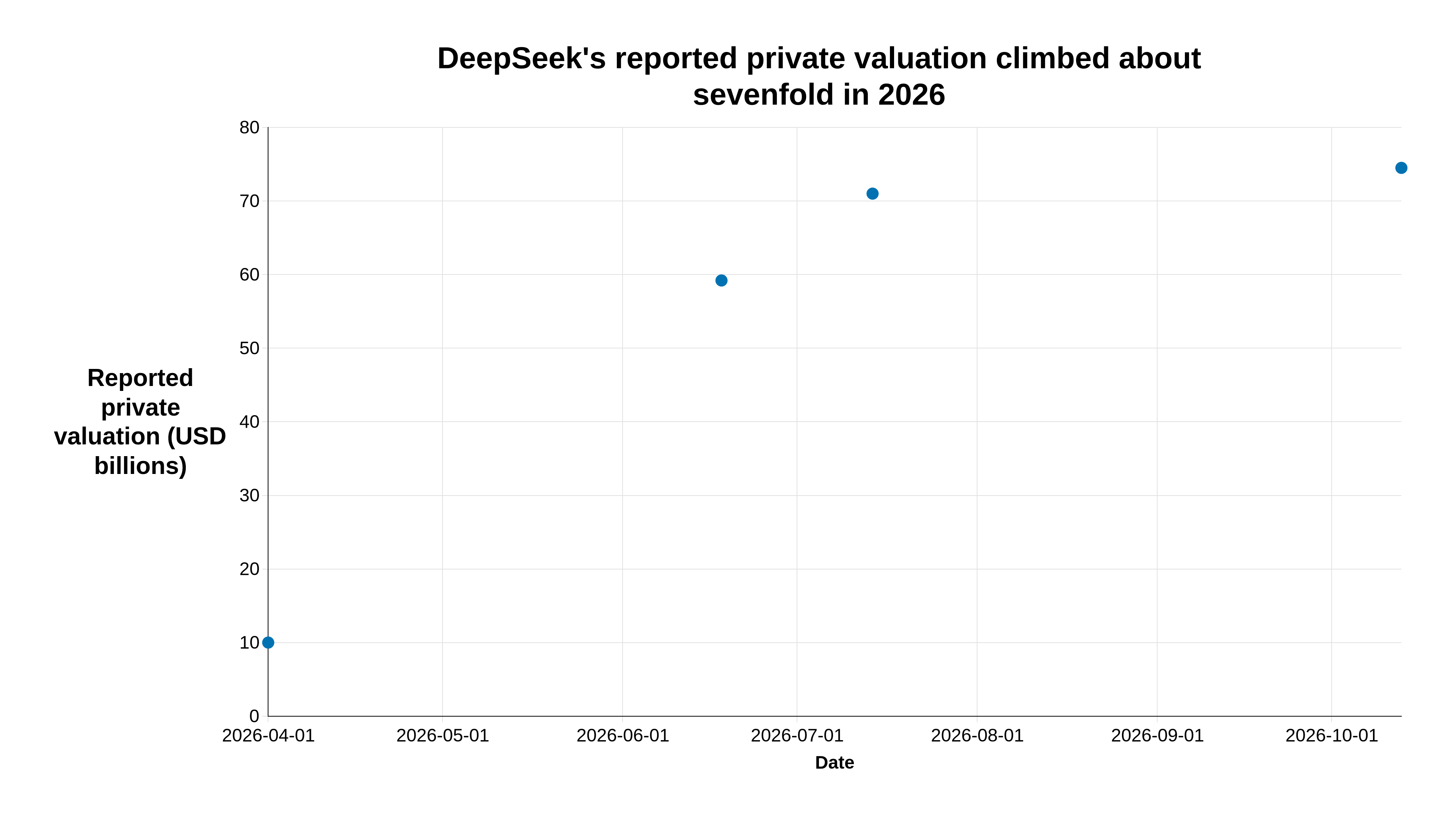
DeepSeek’s second private financing closed at about $15 billion with a reported valuation of roughly $74 billion going into the final close, after a June round that raised about $7.4 billion at a Caixin-reported post-money valuation of about $52 billion. A second, independent SI Plots dataset already showed DeepSeek’s reported private valuation rising sharply across 2026 toward about $74–75 billion (DeepSeek’s reported private valuation climbed about sevenfold in 2026); this chart adds the capital raised in each round and uses the Caixin post-money figure for June rather than other reported June marks. That paired raise-and-valuation path is the quantitative core of the SI News report that DeepSeek nearly doubled its fundraising target amid strong investor demand ahead of a possible Shanghai listing.
Notes: June 2026 Round 1 capital raised (~$7.4B) and post-money valuation (~$52B / >350B yuan) from Caixin Global and Reuters reporting. October 2026 Round 2 capital raised (~$15B / ~100B yuan) and pre-close valuation (~$74B) from The Wall Street Journal as reported by PYMNTS and Quartz (2026-10-22). The chart plots Round 1 valuation as post-money and Round 2 valuation as the reported pre-money figure into final close; amounts are from people familiar with the matter and are not a company filing. Observation window: reported closes on or about 2026-06-16 and 2026-10-22. Access date: 2026-10-23.
Independent financing reports place DeepSeek’s reported private valuation near $10 billion in April, about $59.2 billion after its June round, at least $71 billion during July fundraising discussions, and roughly $74.5 billion after the October round. The trajectory puts the current funding story in context: the company’s reported valuation expanded sharply as it moved from rejecting outside capital to raising successive multibillion-dollar rounds.
Meta’s capital expenditures, including finance-lease principal, reached $34.9 billion in the third quarter of 2026, about 4.9 times the $7.1 billion it spent in the first quarter of 2023, while quarterly free cash flow fell from $12.4 billion in the first quarter of 2026 to negative $2.1 billion, its first negative quarter in this series. In other words, Meta’s AI data-center buildout now costs more than all the cash its operations generate, even though third-quarter revenue rose 26% year over year to $64.6 billion. That context matters for the SI News report that Meta raised the floor of its 2026 capex outlook to $135 billion and approved a new share class to help fund the expansion.
Notes: Quarterly figures for Q1 2023 through Q3 2026 in nominal USD billions, rounded to one decimal, as reported in Meta’s earnings press releases (accessed 2026-10-23); points are plotted at each quarter’s end date. Capital expenditures include principal payments on finance leases. Free cash flow is Meta’s non-GAAP measure: cash from operating activities minus purchases of property and equipment and principal payments on finance leases. Meta’s outlook for full-year 2026 capital expenditures is $135-145 billion.
The public OSS Verify index shows only 2.85%–13.71% of recorded proof-status entries marked proved across seven libraries with at least one proof, despite Anthropic’s report of Claude proving security properties for 239 entry points across 123 libraries. That gap matters because the result is a selective verified slice of a much larger fuzzing corpus, not evidence that entire libraries are bug-free, connecting the independent repository data to SI News’s report on scaled formal verification.
PHP’s official lifecycle shows the emergency PHP2Shell fixes can land on 8.2–8.5, whose security support ends from December 2026 through December 2029, but PHP 8.1 and older branches had already reached end of life by the disclosure. That support cliff matters because the AI-assisted discoveries described by SI News affect a widely deployed runtime, yet operators on obsolete branches cannot receive the upstream fix without upgrading. This independently quantifies the remediation window behind the PHP2Shell emergency.
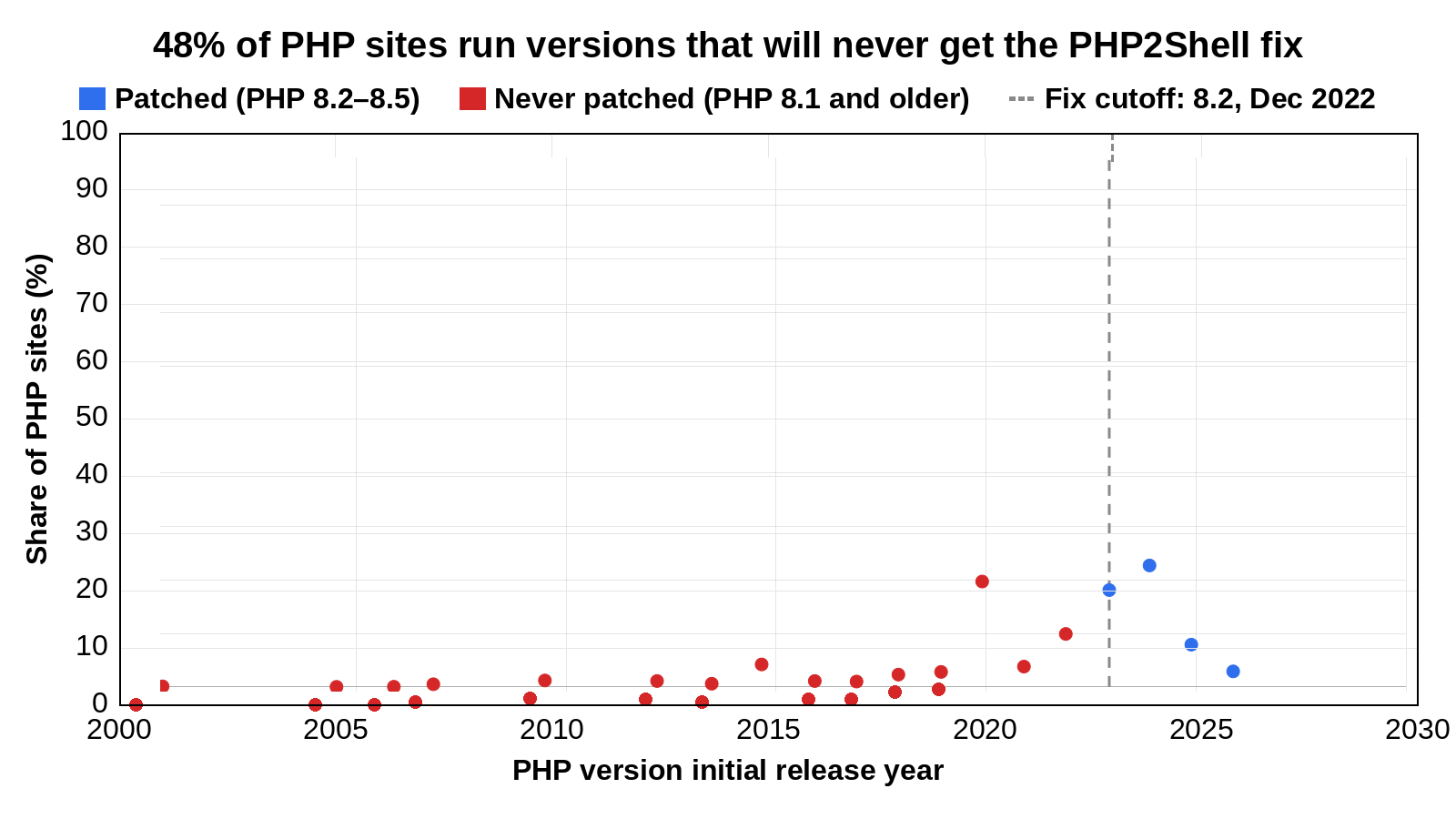
According to W3Techs data captured October 22, 2026, 48.4% of PHP-powered websites run PHP 8.1 or older — versions php.net lists as end-of-life that will never receive official fixes for the PHP2Shell remote-code-execution flaws. The two largest stranded groups are PHP 7.4 at 19.7% of PHP sites (end-of-life since November 2022) and PHP 8.1 at 9.9%; only the 51.6% on PHP 8.2 through 8.5 can patch. With PHP running 69.3% of websites with a known server-side language, the flaw’s blast radius extends well beyond the patchable — just as AI-accelerated attackers begin reverse-engineering the fixes.
Data sources: W3Techs (2026). Usage statistics of PHP for websites (data captured 2026-10-22; per-version shares converted from W3Techs’ per-major-version percentages to % of PHP-using sites); PHP Group (2026). Supported Versions
Notes: PHP 8.1 reached end-of-life 2025-12-31; only versions 8.2–8.5 receive security fixes per php.net. W3Techs surveys high-traffic websites; percentages are shares of PHP-using sites in its sample, not of the entire web. Version 4.x is plotted at PHP 4.0’s 2000-05-22 release date (no subversion breakdown published).