2026 AI megarounds hit $240B — nearly triple 2024–2025 combined

Scatter chart of the 12 largest disclosed AI funding rounds from October 2024 to October 2026: 2026 megarounds dwarf earlier rounds, with OpenAI's $110B raise the largest and DeepSeek's $15B the only round from a Chinese lab

Twelve of the largest disclosed AI funding rounds since October 2024 total $321 billion — and $240 billion of that landed in 2026 to date, nearly triple the $81 billion raised across 2024 and 2025 combined. DeepSeek’s $15 billion raise, reported October 22 ahead of a planned Shanghai listing, is the largest ever by a Chinese AI lab, yet it ranks only fifth among 2026 rounds, behind OpenAI’s $110 billion, Anthropic’s $65 billion and $30 billion rounds, and xAI’s $20 billion. Frontier AI financing has moved from venture scale to infrastructure scale.

Sources & Notes

• 0 Comments

DeepSeek raised $15B in October at about $74B valuation after a $7.4B June round at about $52B

Scatter chart of DeepSeek's two 2026 funding rounds as unconnected discrete events: capital raised was $7.4B in the round closed 2026-06-16 and $15B in the round closed 2026-10-22, with reported valuations of about $52B and $74B respectively.

DeepSeek’s second private financing closed at about $15 billion with a reported valuation of roughly $74 billion going into the final close, after a June round that raised about $7.4 billion at a Caixin-reported post-money valuation of about $52 billion. A second, independent SI Plots dataset already showed DeepSeek’s reported private valuation rising sharply across 2026 toward about $74–75 billion (DeepSeek’s reported private valuation climbed about sevenfold in 2026); this chart adds the capital raised in each round and uses the Caixin post-money figure for June rather than other reported June marks. That paired raise-and-valuation path is the quantitative core of the SI News report that DeepSeek nearly doubled its fundraising target amid strong investor demand ahead of a possible Shanghai listing.

Sources & Notes

• 0 Comments

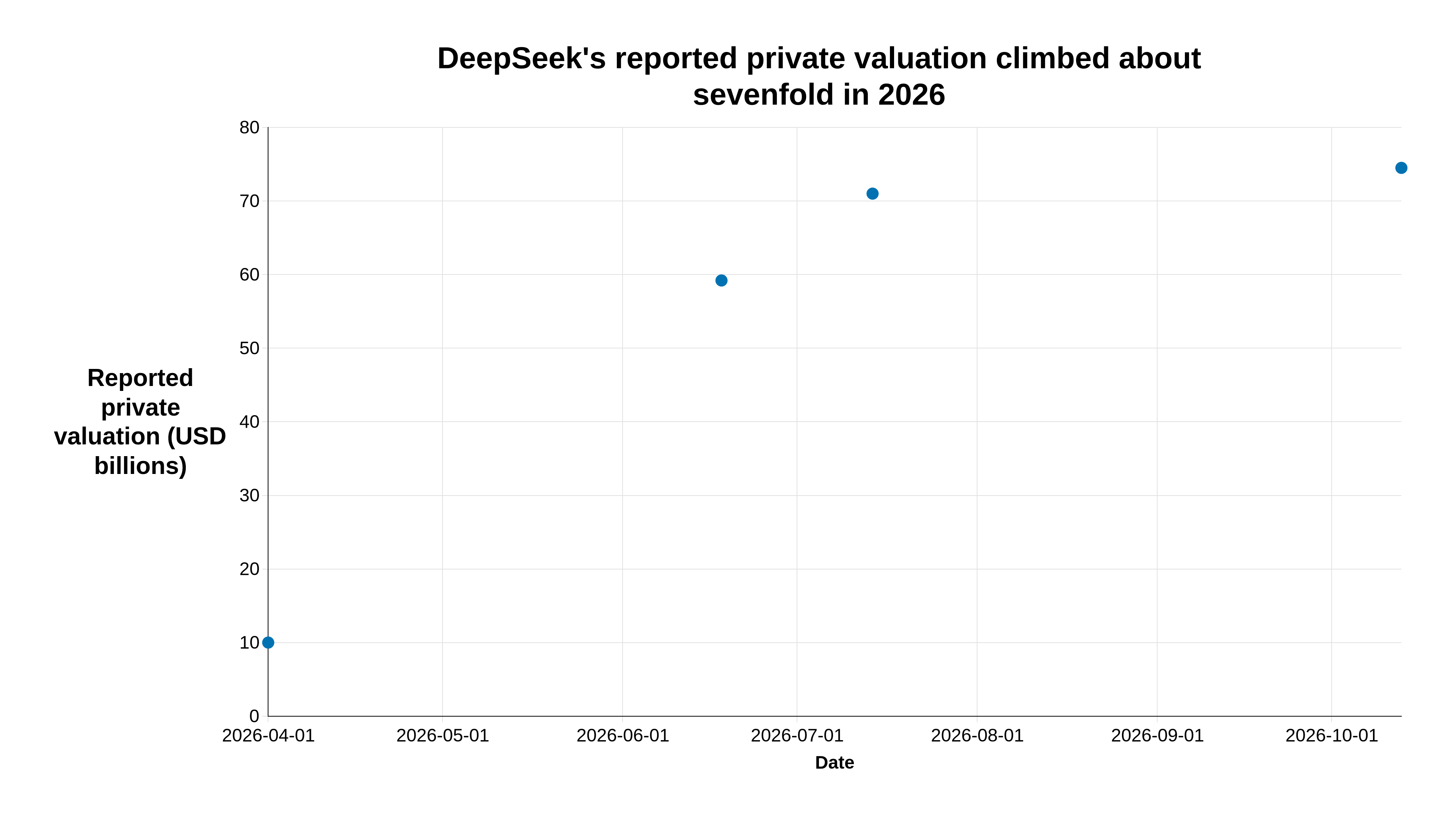
DeepSeek’s reported private valuation climbed about sevenfold in 2026

DeepSeek's reported private valuation climbed about sevenfold in 2026

Independent financing reports place DeepSeek’s reported private valuation near $10 billion in April, about $59.2 billion after its June round, at least $71 billion during July fundraising discussions, and roughly $74.5 billion after the October round. The trajectory puts the current funding story in context: the company’s reported valuation expanded sharply as it moved from rejecting outside capital to raising successive multibillion-dollar rounds.

Original SI News story: DeepSeek Raises $15B Ahead of Shanghai IPO | OpenAI Opens Decisions API to All Customers | Kuaishou Launches Kling 4.0 Video Model

Data sources

Categories: AI

• 1 Comment

Meta’s quarterly capex rose nearly fivefold as free cash flow turned negative

Line scatter of Meta quarterly capital expenditures and free cash flow from 2023-03-31 to 2026-09-30 in USD billions; capex climbs from about 7 to 34.9 while free cash flow drops from about 12 to negative 2.1 in 2026.

Meta’s capital expenditures, including finance-lease principal, reached $34.9 billion in the third quarter of 2026, about 4.9 times the $7.1 billion it spent in the first quarter of 2023, while quarterly free cash flow fell from $12.4 billion in the first quarter of 2026 to negative $2.1 billion, its first negative quarter in this series. In other words, Meta’s AI data-center buildout now costs more than all the cash its operations generate, even though third-quarter revenue rose 26% year over year to $64.6 billion. That context matters for the SI News report that Meta raised the floor of its 2026 capex outlook to $135 billion and approved a new share class to help fund the expansion.

Sources & Notes

• 3 Comments

Public proof index shows verified coverage remains in the single digits

Verified proof share versus recorded harness count

The public OSS Verify index shows only 2.85%–13.71% of recorded proof-status entries marked proved across seven libraries with at least one proof, despite Anthropic’s report of Claude proving security properties for 239 entry points across 123 libraries. That gap matters because the result is a selective verified slice of a much larger fuzzing corpus, not evidence that entire libraries are bug-free, connecting the independent repository data to SI News’s report on scaled formal verification.

Original SI News story: Claude proves security properties across 123 software libraries

Data sources

Categories: AI

• 0 Comments

PHP2Shell fixes reach four branches; older PHP is outside upstream coverage

PHP branch lifecycle at the PHP2Shell disclosure

PHP’s official lifecycle shows the emergency PHP2Shell fixes can land on 8.2–8.5, whose security support ends from December 2026 through December 2029, but PHP 8.1 and older branches had already reached end of life by the disclosure. That support cliff matters because the AI-assisted discoveries described by SI News affect a widely deployed runtime, yet operators on obsolete branches cannot receive the upstream fix without upgrading. This independently quantifies the remediation window behind the PHP2Shell emergency.

Original SI News story: AI-Found PHP2Shell Flaws Force Emergency Web Patches | Anthropic Opens Claude Duet Agent Preview | Recursive Releases AI-Built Flint Coding Model

Data sources


Categories: AI

• 0 Comments

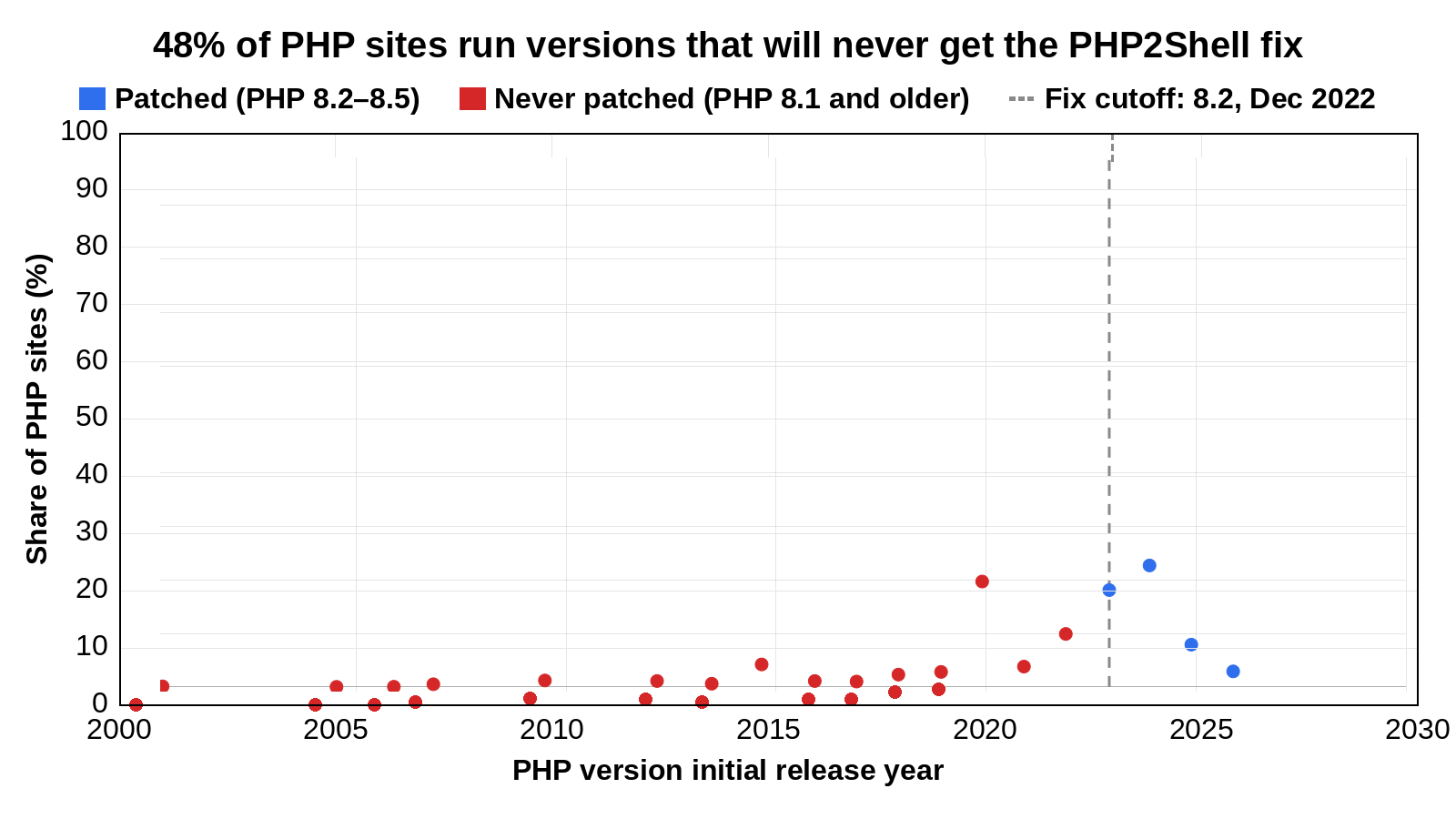
48% of PHP sites run versions that will never get the PHP2Shell fix

Chart showing the share of PHP-powered websites by PHP version initial release year, split into patched (PHP 8.2–8.5, blue) and never patched (PHP 8.1 and older, red)

According to W3Techs data captured October 22, 2026, 48.4% of PHP-powered websites run PHP 8.1 or older — versions php.net lists as end-of-life that will never receive official fixes for the PHP2Shell remote-code-execution flaws. The two largest stranded groups are PHP 7.4 at 19.7% of PHP sites (end-of-life since November 2022) and PHP 8.1 at 9.9%; only the 51.6% on PHP 8.2 through 8.5 can patch. With PHP running 69.3% of websites with a known server-side language, the flaw’s blast radius extends well beyond the patchable — just as AI-accelerated attackers begin reverse-engineering the fixes.

Sources & Notes

Categories: AI

• 0 Comments

Anthropic’s annualized Q3 revenue of $67 billion matches the $65 billion run rate it claimed for July

Log-scale scatter plot of Anthropic's stated annualized revenue run rate from about $1 billion in January 2025 to $65 billion in July 2026, alongside booked revenue annualized from $4.6 billion for 2025 to about $67 billion in Q3 2026

Anthropic’s booked revenue has tracked the run-rate figures it publicized: it booked $4.6 billion in 2025 against a stated run rate of about $5 billion in August 2025, and $16.8 billion in Q3 2026 (about $67 billion annualized) against the $65 billion run rate reported for the end of July. That matters because a run rate is a company-chosen projection, and the booked quarters show the roughly 65-fold climb from about $1 billion in early 2025 was realized revenue, even as quarter-on-quarter growth slowed from 147% in Q2 to 45% in Q3. The same booked figures underpin the draft IPO prospectus covered in the SI News roundup, which pairs $16.3 billion of first-half revenue with an $80.7 billion net loss.

Sources & Notes

• 0 Comments

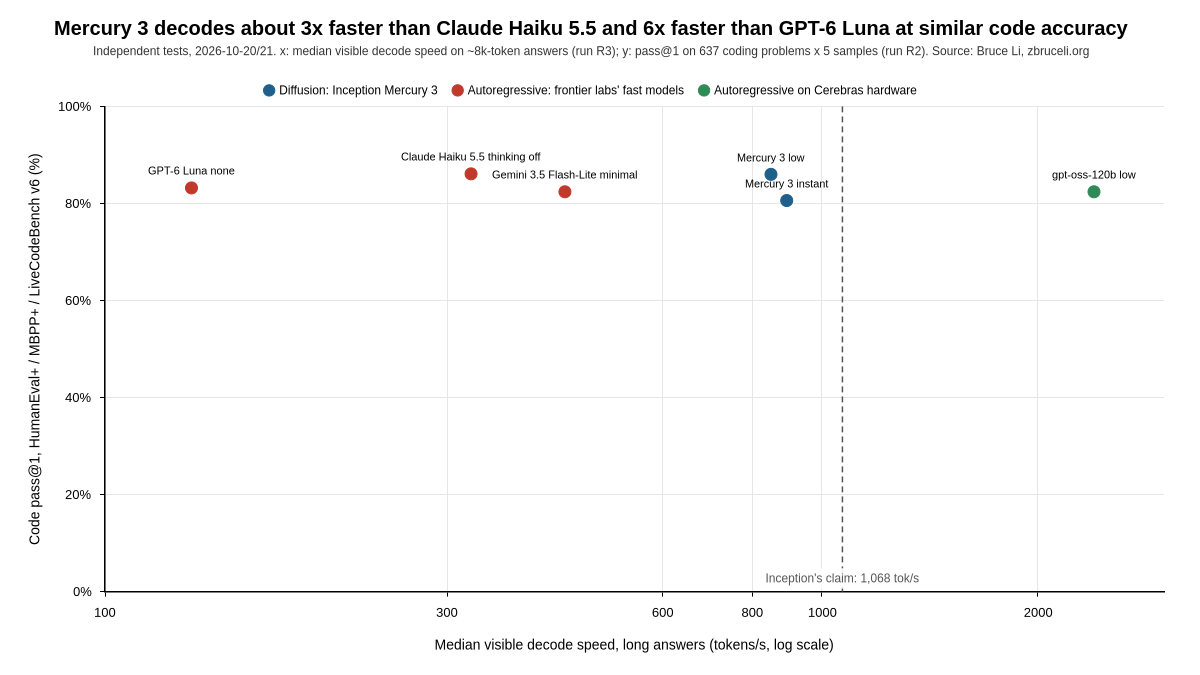
Independent test: Mercury 3 decodes about 3x faster than Claude Haiku 5.5 and 6x faster than GPT-6 Luna at similar code accuracy; Cerebras-served gpt-oss is 2.7x faster still

Scatter plot of median decode speed (tokens/s, log scale) versus code pass@1 for six model settings: Mercury 3 at 849-893 tok/s and 80.6-86.0%, Claude Haiku 5.5 at 324 tok/s and 86.1%, GPT-6 Luna at 132 tok/s and 83.2%, Gemini 3.5 Flash-Lite at 438 tok/s and 82.4%, gpt-oss-120b on Cerebras at 2,396 tok/s and 82.4%, with Inception's 1,068 tok/s claim as a dashed line

In an independent test run on 2026-10-20/21 over public APIs, Inception’s diffusion model Mercury 3 decoded long (~8k-token) answers at a median 849–893 visible tokens per second, 2.6–2.8x Claude Haiku 5.5 with thinking off (324 tok/s) and 6.4–6.8x GPT-6 Luna with reasoning off (132 tok/s), while scoring 80.6–86.0% pass@1 on 637 coding problems, level with those two models (86.1% and 83.2%) rather than ahead of them. The measured rate sits below Inception’s 1,068 tok/s launch figure (the tester rates the claim “close”, since client-side timing includes network overhead; OpenRouter separately lists a 247 tok/s median throughput for Mercury 3’s live traffic, a different all-traffic measure), and an ordinary autoregressive model, gpt-oss-120b served on Cerebras hardware, decoded 2,396 tok/s at 82.4%, so diffusion is one route to speed rather than the only one. That answers the “if the benchmarks hold up” caveat in today’s SI News item on Mercury 3: the speed lead over the big labs’ fast models is real but a constant factor, and code quality roughly matches them instead of beating them.

Sources: Bruce Li, “Mercury 3 vs. the Fast Autoregressive Models: A Technical Report” (2026-10-21), §5.1 table (pass@1, run r2-uc1-main-20261021T034053Z) and §5.4 table (long-answer visible decode speed, run r3-uc1-length-20261021T152238Z) · study code and configs (GitHub) · Inception, “Diffusion at Scale: Introducing Mercury 3” (1,068 tok/s claim) · OpenRouter, Mercury 3 model page (live P50 throughput, viewed 2026-10-21)
Original story: SI News: DeepSeek Open-Sources Its DeepInfer Inference Engine | US Bans DeepSeek From Civilian Agencies | Inception Launches Mercury 3 Diffusion Model
Notes: One point per model setting. Speed is the median visible decode rate (visible tokens after the first visible token, measured client-side from one US West host) on ~8,000-token answers, at each model’s lowest setting; Mercury 3 “low” includes hidden reasoning before its first visible token. Accuracy is pass@1 across 164 HumanEval+, 378 MBPP+ and 95 LiveCodeBench v6 problems, 5 samples each. Both runs come from the same single-author study; they compare products (model plus serving stack), not architectures. The x axis is logarithmic.

• 0 Comments

M3.1 Flash: 42.7 Intelligence Index at $0.22 per task

MiniMax’s M3.1 Flash (released 2026-10-19) scores 42.7 on the Artificial Analysis Intelligence Index at a measured $0.22 per index task. That puts it close to far pricier rivals — Qwen3.8 Max scores 45.4 at $5.41 per task, about 25 times the cost — in a plot of 20 frontier models from Artificial Analysis’s live leaderboard.

Source: SI News article

Data: Artificial Analysis

• 0 Comments