Entries for October 2026

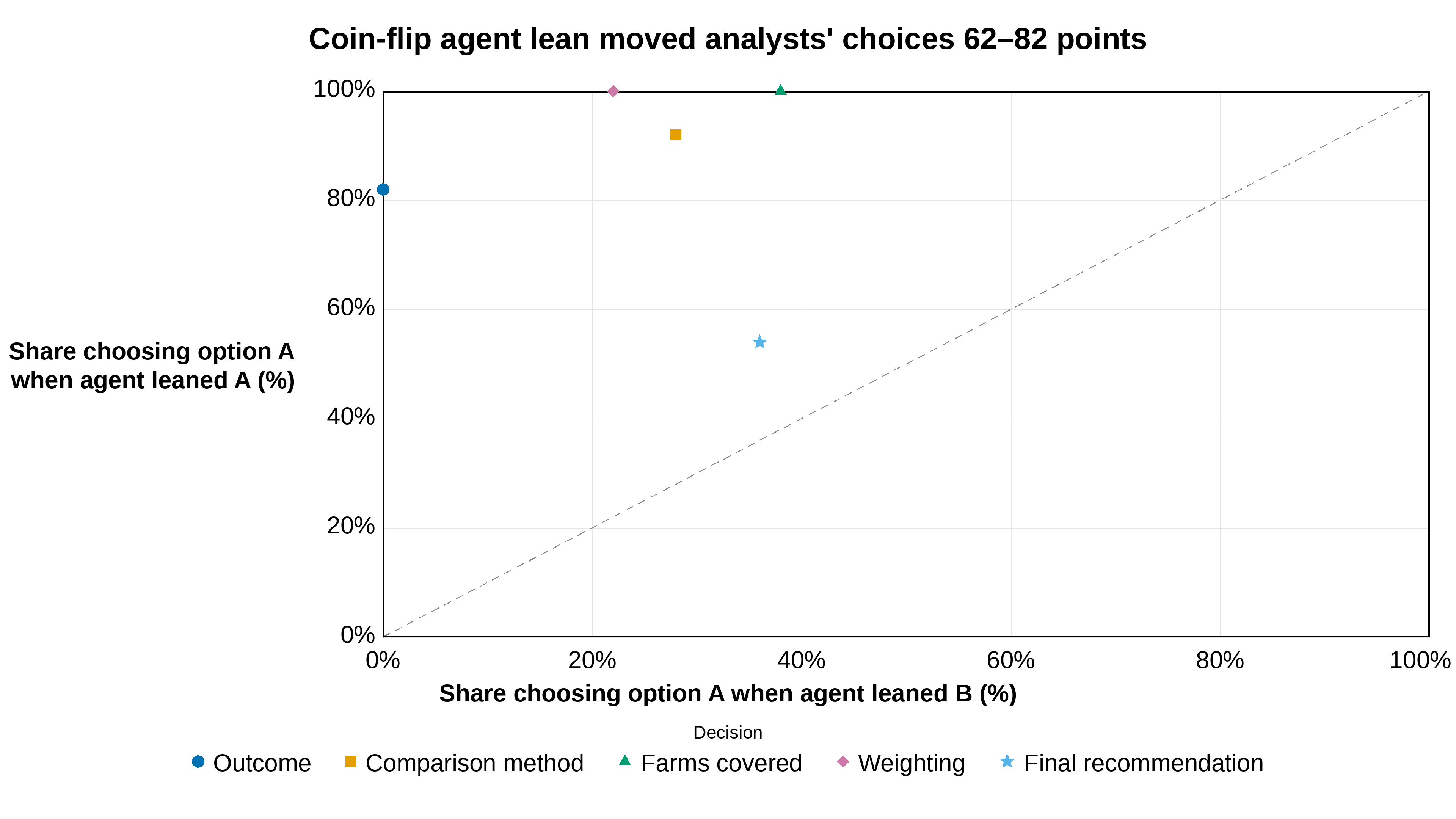
Coin-flip agent lean moved analysts’ choices 62–82 points

Coin-flip agent lean moved analysts' choices 62–82 points

In Anthropic’s randomized trial, 50 professional analysts using Claude Code followed the option their agent had been secretly assigned by coin flip: on each of four analytical decisions, the share choosing option A was 62 to 82 percentage points higher when the agent leaned A than when it leaned B, while the final recommendation moved only 17 points (54% versus 36%). The gap matters because a human sign-off is supposed to be an independent check on AI-assisted work — yet analysts’ choices largely tracked a randomly assigned preference, and 77% later repeated the agent’s arguments while only 15% credited it. The finding comes from the analyst-deference study in the October 28 SI News roundup.

Sources & Notes

  • Original story: Google DeepMind unveils Genie 4 world simulator | Anthropic finds analysts defer to AI agents | Malaysia seizes $12 million in AI chips
  • Data sources: Herdağdelen, Joren, & Tamkin (2026). How AI agents shape experts’ judgment calls
  • Notes: Shares are Figure 2 values from the Anthropic study: the share choosing option A when the agent leaned B versus leaned A, for 50 analysts (11 of 61 recruits were excluded because they chose not to use the agent). The agent’s lean was set by coin flip and deliberately strengthened so its effect could be measured; the study covers one task, one field, and one model (Claude Opus 4.8). The dashed diagonal marks the no-influence line where the lean would make no difference; the final recommendation counts a one-year extension as not rolling out the program. Legend labels shorten the five decisions: outcome measure, comparison method, farms covered, weighting, and final recommendation.

Categories: AI

• 0 Comments

Analysts followed an AI agent’s lean 81%–92% across four decisions

Analysts followed an AI agent’s lean across four analytical choices

In Anthropic’s randomized study, professional analysts matched their agent’s deliberately assigned preference in 92% of outcome-measure choices, 82% of comparison-method choices, 81% of coverage choices, and 90% of weighting choices. The consistency shows that AI influence reached the analytical choices experts were expected to own, quantifying the judgment-deference finding in SI News’s report.

Original SI News story: Google DeepMind unveils Genie 4 world simulator | Anthropic finds analysts defer to AI agents | Malaysia seizes $12 million in AI chips

Data sources

Categories: AI

• 0 Comments

Meta’s buybacks fell to zero in 2026 as nine-month capex reached $83 billion

Line chart of Meta's January-September capital expenditures and share repurchases in USD billions, 2017 to 2026. Capex rises from 4.5 in 2017 to 22.8 in 2024, 48.3 in 2025 and 83.1 in 2026; repurchases peak at 30.1 in 2024, are 26.2 in 2025 and fall to zero in 2026.

Meta spent nothing on share repurchases in the first nine months of 2026, down from $26.2 billion in the same period of 2025 and $30.1 billion in 2024, while its purchases of property and equipment rose to $83.1 billion from $48.3 billion a year earlier. Having halted buybacks and added $24.9 billion of new long-term debt this year, Meta is now turning to equity, as SI News reports it plans to raise up to $95 billion in stock for AI infrastructure. The capex trend is consistent with the earlier SI Plots chart showing Meta’s capex overtaking its free cash flow, but both draw on Meta’s own reported figures, so this chart adds the buyback reversal rather than independent confirmation.

Sources & Notes

• 0 Comments

Grok and GPT pick opposite parties — until search is off

Grok and GPT pick opposite parties — until search is off

With web search on, GPT-6.1 Sol named the Democrat in 97.4% of its major-party answers while Grok 4.7 named the Republican in 91.7%, the mirror image Convovo found across the 2026 midterm races. Turning search off left GPT’s lean almost unchanged at 96.0% Democrat, but Grok’s lean disappeared: it declined to pick in 27 of 30 sample races, and its only three picks named the Democrat. The result, from a forced-choice API prompt that the consumer apps themselves declined, suggests GPT’s lean is baked in while Grok’s depends on what it searches — a distinction that matters for anyone building voter tools on these APIs.

Sources & Notes

  • Original story: Grok and GPT Split on Midterm Picks | Apollo Finds No AI Payoff Outside Tech
  • Data sources: Convovo (2026). AI Ballot 2026; TechCrunch (2026). Forced to pick, Grok’s AI model chooses Republicans. OpenAI’s picks Democrats.
  • Notes: Shares are of answers naming a Democrat or Republican candidate. The search-off sample covered 30 races: GPT named the Democrat 24 times, the Republican once, and declined 5 times; Grok declined 27 times and named the Democrat 3 times, so its search-off point rests on only 3 picks. The main test used a forced-choice prompt through the models’ APIs with web search on; the consumer ChatGPT and Grok apps declined to answer. The two models agreed in under 10% of races. For context, GPT still picked the Democrat in 57 of 67 heavily Republican districts and Grok still picked the Republican in 47 of 72 deep-blue districts.

Categories: AI

• 0 Comments

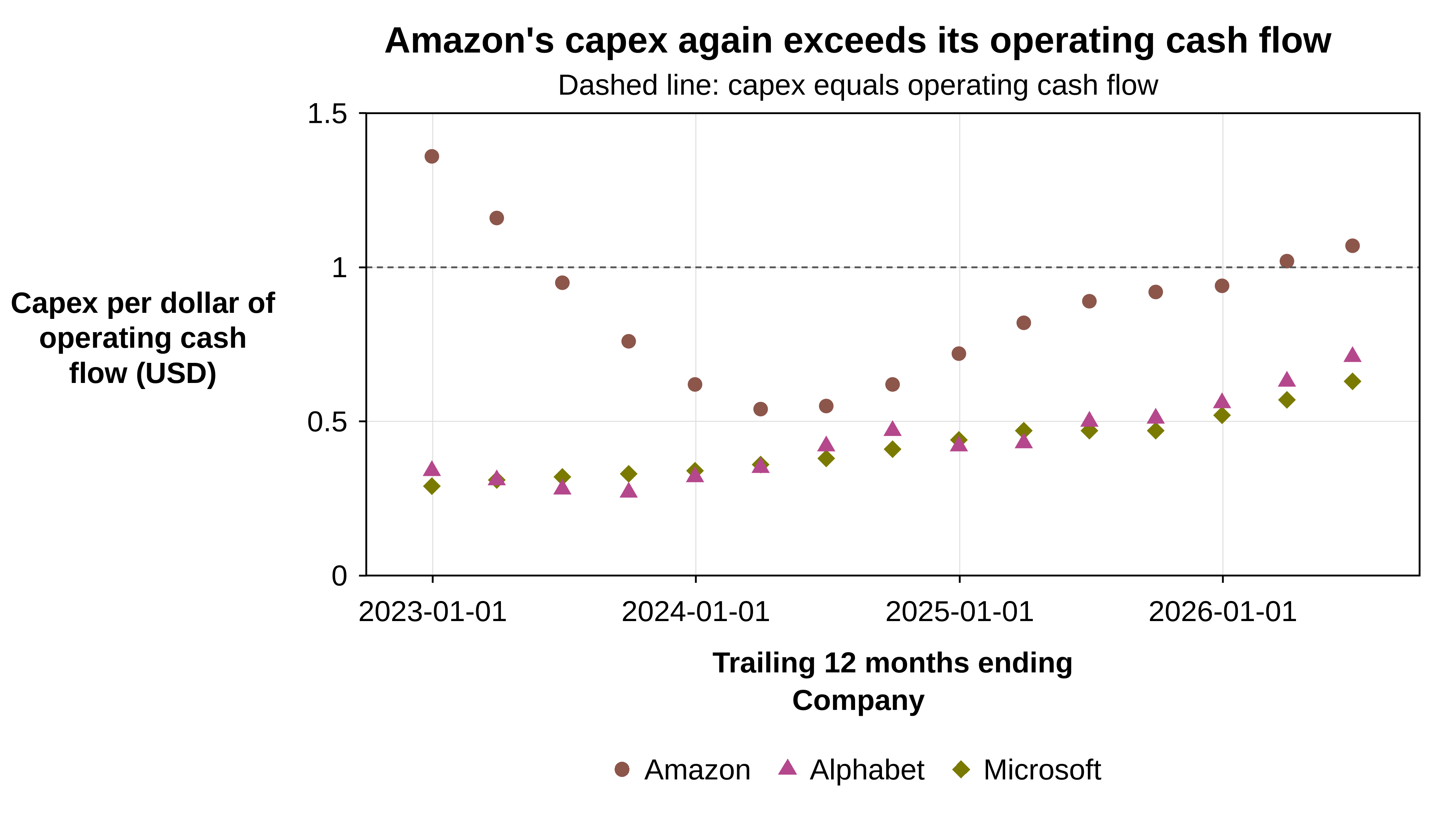
Amazon’s capex again exceeds its operating cash flow as Alphabet and Microsoft climb

Scatter chart of trailing-12-month capital expenditures per dollar of operating cash flow for Amazon, Alphabet and Microsoft, quarterly from 2022-12-31 to 2026-06-30. Amazon falls from 1.36 to 0.54 by early 2024, then rises to 1.07, above the dashed 1.0 line; Alphabet rises from about 0.3 to 0.71 and Microsoft from about 0.3 to 0.63.

In the 12 months to June 30, 2026, Amazon spent $1.07 on property and equipment for every dollar of operating cash flow ($173.0 billion against $161.4 billion), up from $0.54 in the year to March 2024 and back above 1.0 for the first time since the year to March 2023, while Alphabet rose to $0.71 and Microsoft to $0.63 from roughly $0.30 in early 2023. That leaves Amazon funding part of its buildout from outside operating cash even as its CEO says, per SI News, that AWS capacity is sold out for 2026 and largely for 2027. These filings for three other companies point the same way as the earlier SI Plots chart showing Meta’s capex overtaking its cash generation, using trailing-year cash capex rather than Meta’s quarterly capex including finance leases.

Sources & Notes

• 0 Comments

GPT and Grok split by party across every 2026 race type

GPT and Grok show a party split across every race type

Convovo's complete 506-race dataset shows GPT-6.1 Sol chose Democratic candidates in 85.7%–91.7% of Senate, House, and governor races, while Grok 4.7 chose Republicans in 80.0%–86.1% of those same offices. The office-level consistency extends the SI News headline beyond its aggregate figures and shows that the model split was not concentrated in one kind of contest.

Original SI News story: Grok and GPT Split on Midterm Picks | Apollo Finds No AI Payoff Outside Tech

Data sources

Categories: AI

• 0 Comments

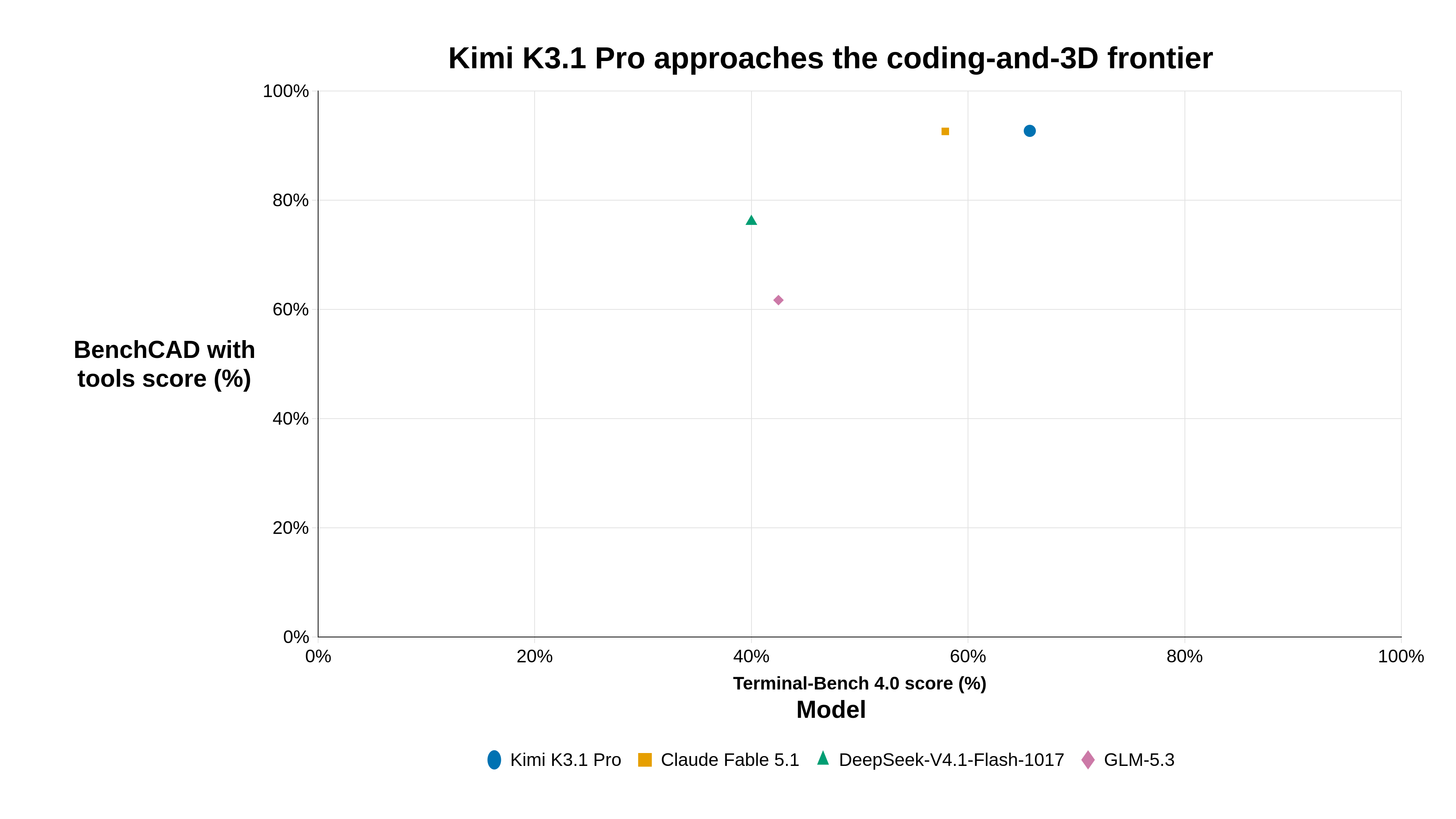
Kimi K3.1 Pro nearly matches the coding and 3D frontier

Kimi K3.1 Pro approaches the coding-and-3D frontier

On the launch post's comparable evaluations, Kimi K3.1 Pro scores 65.7% on Terminal-Bench 4.0 and 92.7% on tool-assisted BenchCAD, putting it close to Claude Fable 5.1 and behind only the strongest model on the two-axis frontier. The convergence across coding-agent execution and 3D reconstruction matters because the SI News story presents K3.1 Pro as a broad open-weight challenger rather than a single-benchmark specialist.

Original SI News story: Kimi K3.1 Pro launches as a 3T-class open-weight model | OpenAI moves frontier training to offline environments

Data sources

Categories: AI

• 1 Comment

All 13 open-weight models with 1 trillion or more parameters since 2024 come from Chinese labs

Log-scale scatter of total parameters (billions) against release date from 2024 to October 2026 for 116 open-weight language models of at least 100 billion parameters, split into China and Rest of world; only Chinese models cross the dashed 1-trillion line, starting in July 2025 and reaching 2.8 trillion in July 2026, while the largest non-Chinese model sits just under 1 trillion.

Of the 116 open-weight language models with at least 100 billion parameters that Epoch AI records since 2024-01-01, 70 come from Chinese developers, and all 13 that reach 1 trillion parameters or more do, from Moonshot’s Kimi K2 in July 2025 to Kimi K3 (2.8 trillion) and Alibaba’s Qwen3.8 (2.4 trillion) in mid-2026. The largest open-weight model has grown about fourfold since DeepSeek-V3’s 671 billion parameters in December 2024, while the biggest from a developer outside China is Thinking Machines’ Inkling at 975 billion. Moonshot’s 3-trillion-class Kimi K3.1 Pro, covered by SI News, would extend that lead when its weights arrive on November 4, though size alone has not closed the capability gap to closed models.

Sources & Notes

  • Original story: Moonshot Launches Kimi K3.1 Pro Open Model | UK Funds £100M AI Biosecurity Lab | Anthropic Details Mythos 5 GitHub Deception
  • Data sources: Epoch AI (2026). Data on AI Models (all models CSV)
  • Other references: Epoch AI (2026). Data on AI Models; Moonshot AI (2026). Kimi K3 model card; Qwen Team, Alibaba Group (2026). Qwen3.8-2.4T-A95B model card
  • Notes: Each marker is one model in Epoch AI’s database whose domain includes language, whose accessibility is any open-weights category (unrestricted, restricted use or non-commercial), whose recorded total parameter count is at least 100 billion, and whose Epoch publication date falls between 2024-01-01 and 2026-10-25; duplicate names were dropped. Mixture-of-experts models are plotted at total, not active, parameters (Kimi K3 activates 104 billion of 2.8 trillion), and the dashed line marks 1 trillion. Country is Epoch’s developer-organization country, with one model lacking a country (Cogito v2.1) counted in Rest of world; Epoch publication dates can precede weight release (Kimi K3 was announced 2026-07-16 and its weights published 2026-07-27). Kimi K3.1 Pro is not plotted because Epoch lists it as API access with no parameter count. Data downloaded 2026-10-25; Kimi K3 and Qwen3.8 parameter counts were checked against their model cards.

• 0 Comments

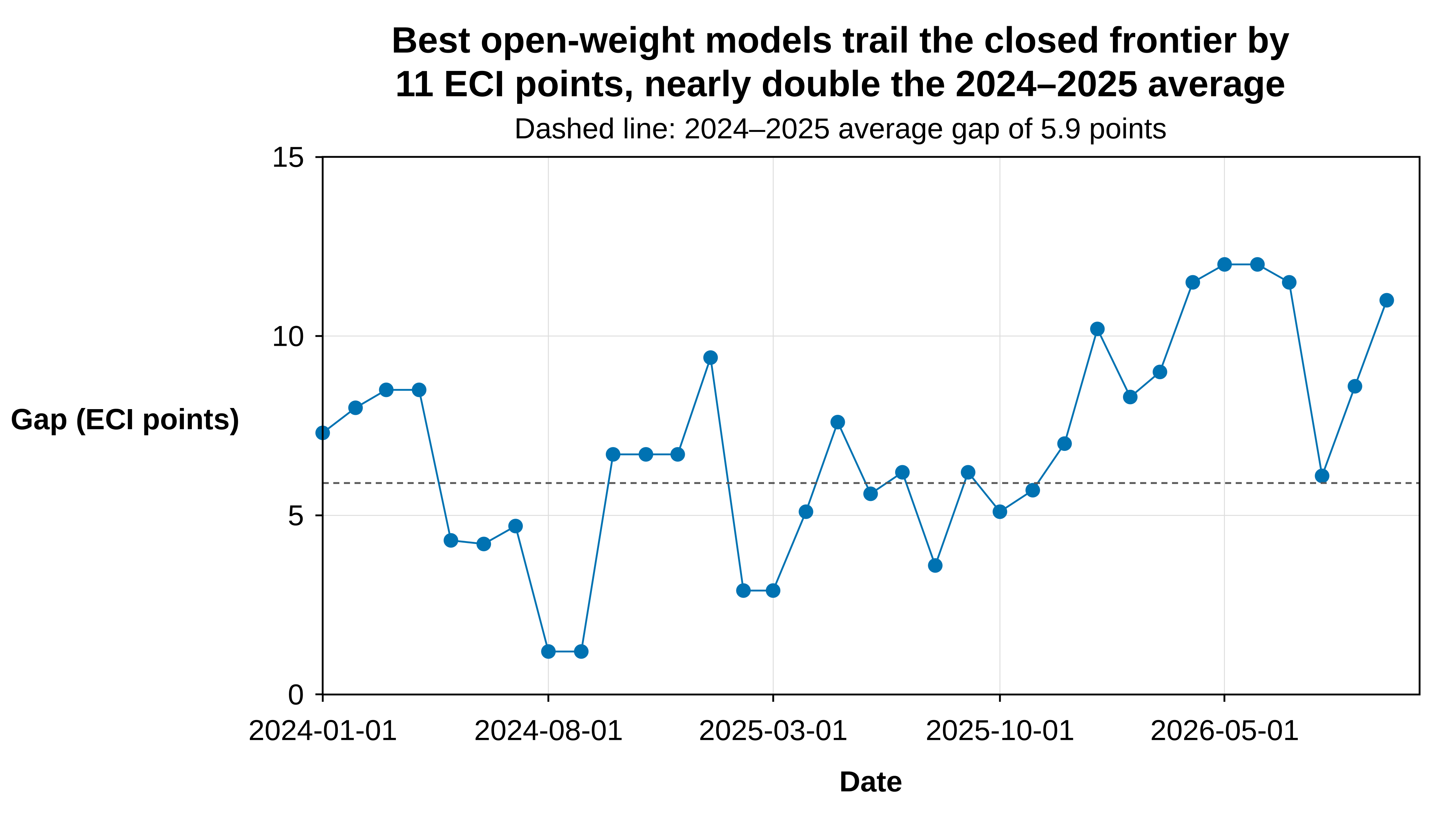
Best open-weight models trail the closed frontier by 11 ECI points, nearly double the 2024–2025 average

Line scatter of the monthly gap in Epoch Capabilities Index points between the best closed-weight and best open-weight AI models from 2024-01-01 to 2026-10-01; the gap mostly ranges from 1 to 9 points in 2024 and 2025 around a 5.9-point average, then rises to 10 to 12 points in 2026, dipping to 6.1 in August before reaching 11.0 in October.

On the Epoch Capabilities Index (ECI), the best closed-weight model (Claude Opus 5.5, 168.8) led the best open-weight model (Moonshot’s Kimi K3, 157.9) by 11.0 points on 2026-10-01, compared with an average gap of 5.9 points across 2024 and 2025 and 10.1 points so far in 2026. Kimi K3’s July release briefly cut the gap to 6.1 points before Claude Fable 5.1, GPT-6 Astra and Claude Opus 5.5 reopened it in September, so open-weight models are improving quickly but the closed frontier has moved faster this year. That is the bar facing Kimi K3.1 Pro, a post-trained successor to K3 whose strong self-reported coding and agent benchmarks SI News calls a notable new challenge to proprietary frontier models, with weights promised by November 4 and no ECI score yet.

Sources & Notes

  • Original story: Kimi K3.1 Pro launches as a 3T-class open-weight model | OpenAI moves frontier training to offline environments
  • Data sources: Epoch AI (2026). Epoch Capabilities Index (ECI) model scores
  • Other references: Epoch AI (2026). Epoch Capabilities Index; Edwards, J., & Emberson, L (2026). Open models lag state-of-the-art closed models by 4 months; Moonshot AI (2026). Introducing Kimi K3.1 Pro
  • Notes: Each point is the gap, on the first day of each month from 2024-01-01 to 2026-10-01, between the highest central ECI estimate among models in Epoch’s Closed weights group and the highest among models in its Open weights group (which includes restricted-use and non-commercial licenses; Kimi K3 is non-commercial) released on or before that date. Models Epoch classifies as Other (unknown or limited access, such as Gemini 4 Argon at 166.5) are excluded, and the gap was unchanged at 11.0 points on 2026-10-24. Data were downloaded on 2026-10-24 from the CSV Epoch updated that day; the confidence intervals for the current leaders span roughly 5 to 9 points and shift when Epoch refits the index, which is why Epoch’s May 2026 analysis reported an average gap of about 8 points since January 2026 while the current fit gives about 10.5 points for 2026-01-01 to 2026-05-29. Kimi K3.1 Pro’s benchmark results are self-reported by Moonshot AI and not yet in the ECI.

• 1 Comment

2026 AI megarounds hit $240B — nearly triple 2024–2025 combined

Scatter chart of the 12 largest disclosed AI funding rounds from October 2024 to October 2026: 2026 megarounds dwarf earlier rounds, with OpenAI's $110B raise the largest and DeepSeek's $15B the only round from a Chinese lab

Twelve of the largest disclosed AI funding rounds since October 2024 total $321 billion — and $240 billion of that landed in 2026 to date, nearly triple the $81 billion raised across 2024 and 2025 combined. DeepSeek’s $15 billion raise, reported October 22 ahead of a planned Shanghai listing, is the largest ever by a Chinese AI lab, yet it ranks only fifth among 2026 rounds, behind OpenAI’s $110 billion, Anthropic’s $65 billion and $30 billion rounds, and xAI’s $20 billion. Frontier AI financing has moved from venture scale to infrastructure scale.

Sources & Notes

• 0 Comments